
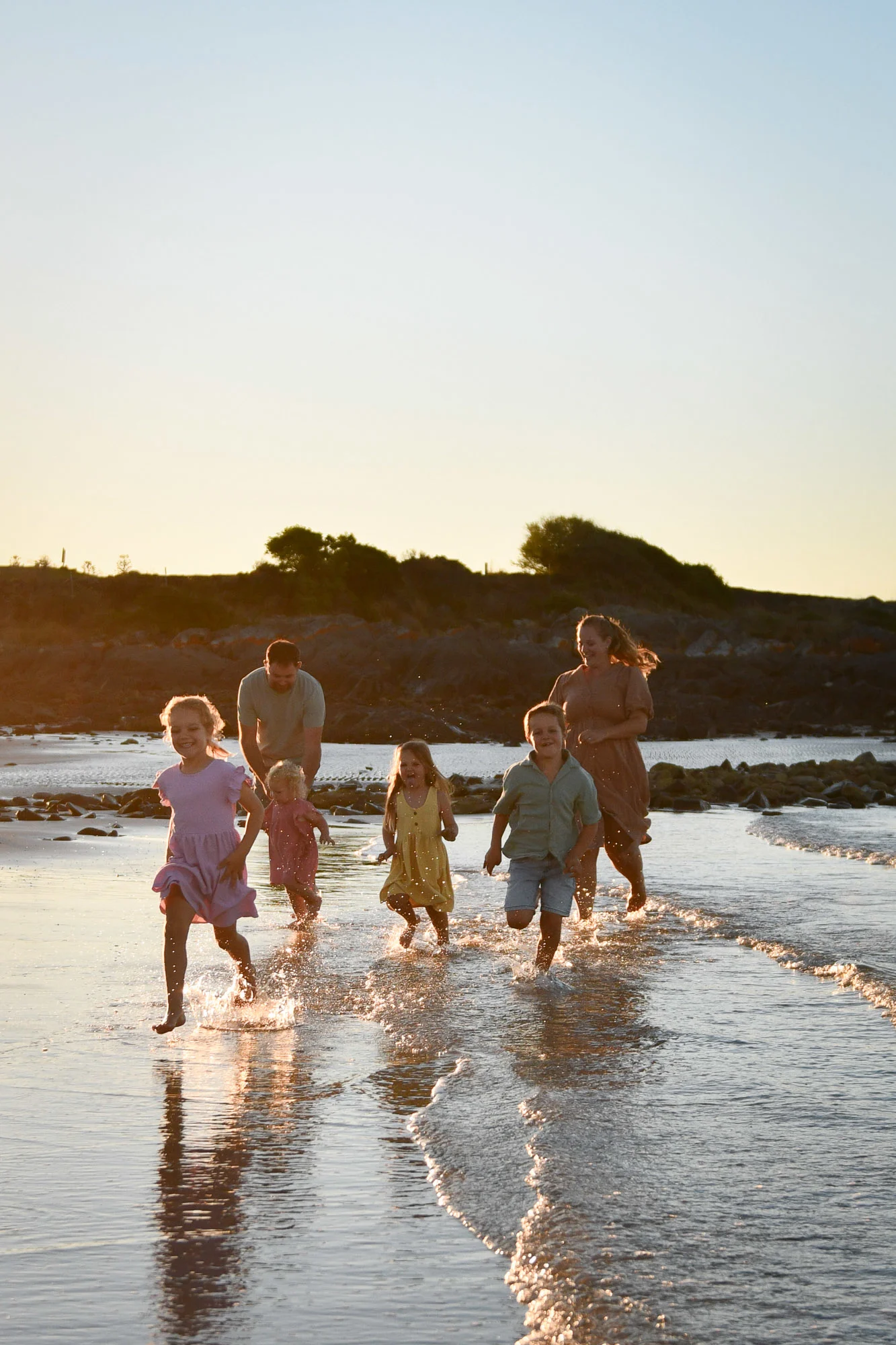
If you've spent any time looking at photography — particularly the kind that makes you stop scrolling and just stare for a moment — you've almost certainly been looking at golden hour light without necessarily knowing that's what it was.
It's that warm, syrupy glow. Soft shadows. Skin that looks lit from within. A quality of light that feels less like a photograph and more like a memory. That's golden hour, and it's the single thing I build almost every session around.
What Golden Hour Actually Is
Golden hour happens twice a day — in the hour or so after sunrise, and in the hour or so before sunset. During these windows, the sun is low on the horizon and its light travels through more of the earth's atmosphere before reaching you. That journey filters out the harsh blue tones and scatters the warm ones, leaving behind that extraordinary golden quality that makes everything look better.
Golden hour forgives almost everything. It softens skin, warms tones, and creates a natural glow that would take hours of editing to replicate artificially — and even then, it never quite looks the same.
What It Does for Your Photos
The difference golden hour makes isn't subtle. In that light, skin tones look warm and alive rather than flat. Backgrounds blur into something glowing rather than harsh and distracting. The fields around Hadspen, the Tamar Valley, the banks of the Cataract Gorge, a simple backyard in suburban Launceston — they all look entirely different at golden hour than they do at any other time of day.
People who feel self-conscious in front of a camera often find it easier in that light too. There's something about the warmth of it that puts people at ease. I've noticed it over and over. The session that felt awkward in the afternoon softens into something easy once the light turns.
That's why I time almost every session around it. Not because it's a rule, but because the results are consistently better. I'd rather set my clients up in conditions where the photographs almost make themselves.
How I Plan Sessions Around It
When you book with me, one of the first things I do is check the sunset time for your session date and work backwards from there. I generally aim to start shooting about 90 minutes before sunset, which gives us time to arrive, settle in, and be in full swing when the best light arrives.
I'll always tell you the time I need you there and explain why. When the light is right it can change fast, and being even fifteen minutes late can mean missing the best of it. I try to be upfront about this rather than vague — I'd rather you understand why the timing matters than feel like I'm being unnecessarily particular about it.
What If Golden Hour Doesn't Work for You
Not everyone can make golden hour work. Young children have bedtimes. Newborns don't care about sunset schedules. Life gets complicated.
If that's you, don't worry. Overcast days produce their own beautiful light — soft, even, and very forgiving. Some of my favourite images have been taken on grey Tasmanian days where the cloud cover did something quiet and lovely with the light. There's a stillness to overcast sessions that suits certain families really well.
For sessions earlier in the day, I look for open shade — under trees, on the sheltered side of a building — which avoids harsh direct sunlight and produces a similar softness. It takes a bit more thought about positioning, but it works.
The goal is always beautiful light. Golden hour is just the most reliable way to get there.
A Practical Note on Booking
Because I time sessions around the light, I'll usually suggest a specific window of time rather than letting you pick freely. If you're hoping for a session on a particular date, it's worth getting in touch sooner rather than later.
I'll also keep an eye on the weather as your date approaches. If conditions change significantly — heavy rain, thick cloud cover that's going to block rather than soften light — I'll reach out and we can discuss whether to proceed or move the date. Tasmanian weather has a mind of its own, and I'd rather reschedule than have you spend money on a session in conditions that aren't going to produce the images you're hoping for.
Why I'll Never Stop Chasing It
A few weeks ago I had a session booked for five o'clock — golden hour. By the time the day arrived it had turned overcast, so I made a call and pushed the start time forward thirty minutes to make sure we had enough light.
The light at 4:30 was soft and really nice. I was happy with it. We moved through the session and the family was wonderful. Then, right around five — my original time — the cloud broke.
The last ten frames of the session were taken in that light. I looked at the back of the camera and my heart sank a little. Not because the photos were bad. Because I could see exactly what they would have been if we'd had that light for the whole session.
The child was done by then. Completely over it. We wrapped up and I drove home thinking about those last ten photos.
I've been photographing families across Launceston and Tasmania for years now, and I still feel a little rush when the light turns. There's something about that particular quality — warm and fleeting and gone before you've properly registered it — that reminds me why I do this job.
The light is what makes a photo feel like more than a photo. It's what makes you look at an image and feel something rather than just see something. And that feeling is exactly what I want you to take home from every session.
If you'd like to talk about booking a session and finding the right time and location to make the most of that beautiful Tasmanian light, I'd love to hear from you.
— Milly